







Quality Assurance
Horizon’s commitment to high-quality vessels guarantees state-of-the-art design, exceptional finish and excellent seakeeping. Each Horizon vessel is subject to stringent and continuous inspections at every stage of the build, from initial lay-up, fit and finish to the final installation of engineering systems.
Each of the four Horizon facilities is independently ISO 9002 approved and utilizes the most advanced technologies to assure quality throughout the production process. Horizon is recognized by the world’s leading classification societies, including Lloyd’s Register (LR), Det Norske Veritas (DNV) and Nippon Kaij Kyokai (NK). Horizon is currently the only yacht builder in Asia that has obtained full DNV Class Classifications.
Tank Test
The hull of a yacht is a very complex hydrodynamic design. Unlike airplanes that only involve the element of air, yachts have to deal with water, air and their interface. The phenomenon is so complicated that no mathematical solution or computer simulation can analyze or predict it- the only realistic way to understand a yacht hull's performance is by testing it in the water.
A tank test is comparable to a wind tunnel for aerospace and automobiles. A 1:8 to 1:12 scale model of the hull design is made and towed along a water-filled tank up to 300 meters in length. A towing cart equipped with many sensors and microprocessors is used to tow the model and collect results for computer analysis on the fly. This is the most accurate and efficient way to fine-tune the design.
Horizon has performed many tank tests in cooperation with various famous international test tanks such as SSPA,HSVA and many local academies including USDDC, NTU, and NTOU. For example, the RP120 performed a series tunnel wedge angle change tests in NCKU to determine the optimized wedge size, and when turned into reality this provided a 1 knot speed increase to the yacht. The Horizon E88 underwent not only resistance tests but also random wave encountering tests in SSPA to ensure a seaworthy yacht , and the most recent test conducted in SSPA was for the design of an 85-footer with an innovative concave hull design. All Horizon yachts are given these regular resistance tests and wave-encountering tests to determine the sea keeping abilities of each hull.
Material Test
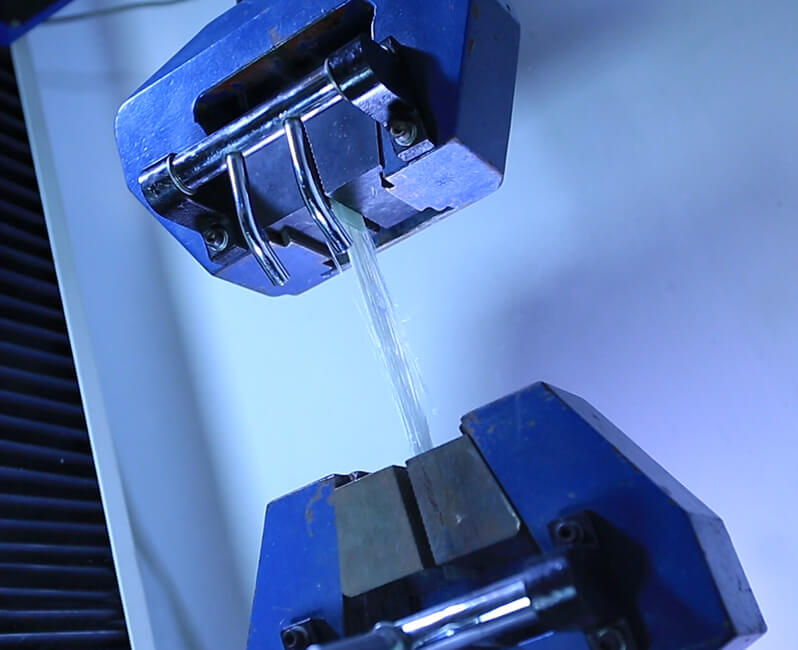
To ensure yacht quality, Horizon begins with the basics: a raw material test. Horizon has its own laboratory to examine raw materials, finished FRP (Fiber Reinforced Plastics) parts and hull appearance. A Universal Testing Machine is equipped to analyze and monitor the properties for raw material assurance – the tests for material properties include tensile strength and modulus, bending strength and modulus, and elongation. These tests refer to ISO 527-4, ASTM C393 or ISO-178 standards, and reference the data from material properties, such as gel coat, resin, fiberglass, structural adhesive and core materials, to check that they have been built up completely and accurately.
In addition, Horizon yacht samples undergo a burn test to measure the fiber content, utilizing a Barcol Impressor to detect the FRP hardness -- fiber content is crucial to analyze the strength of current fibers or the bonding between fiber and resin. The measurement of hardness of FRP ensures that both resin and catalyst are working properly; the fiber content and FRP hardness are also the main parameters in verifying the quality of FRP.
Leak Test
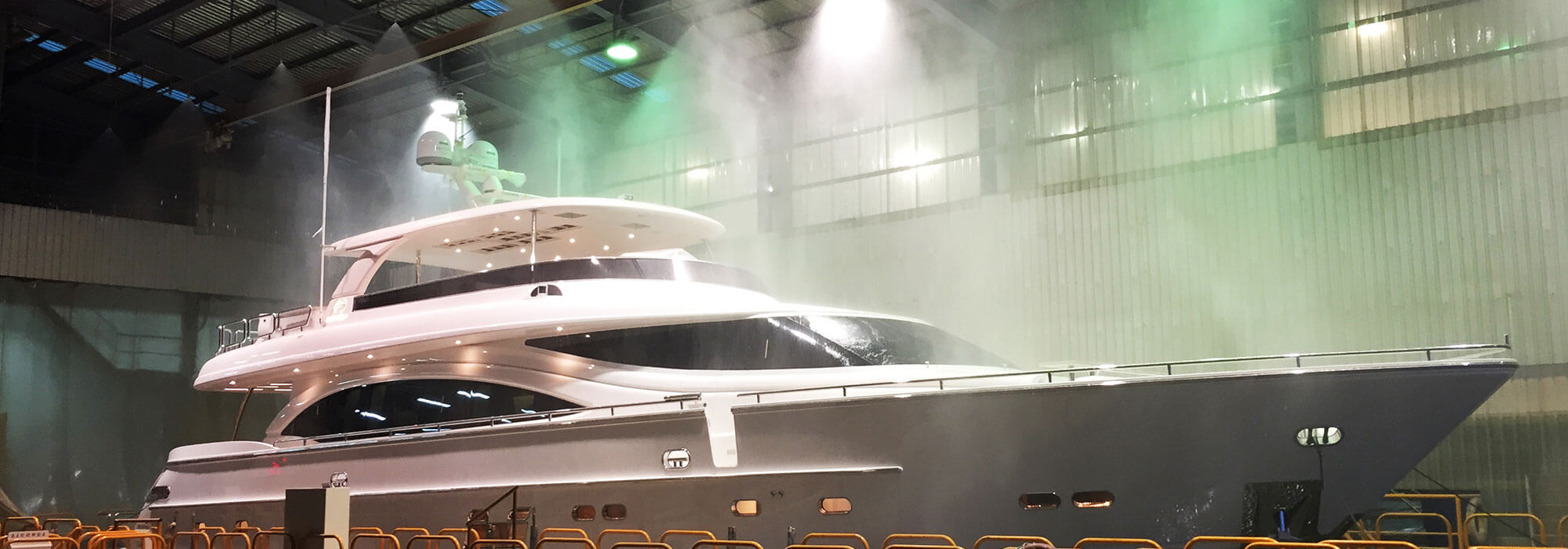
Before delivering a yacht to its owner, Horizon performs a series of water leak tests to ensure that the yacht is completely watertight. The test simulates weather conditions during a monsoon, using thousands of gallons water to shower the yacht from various angles for 2-4 hours. Horizon's leak test is important in guaranteeing the yacht is fully sealed and safe from outside water sources
Sea Trial
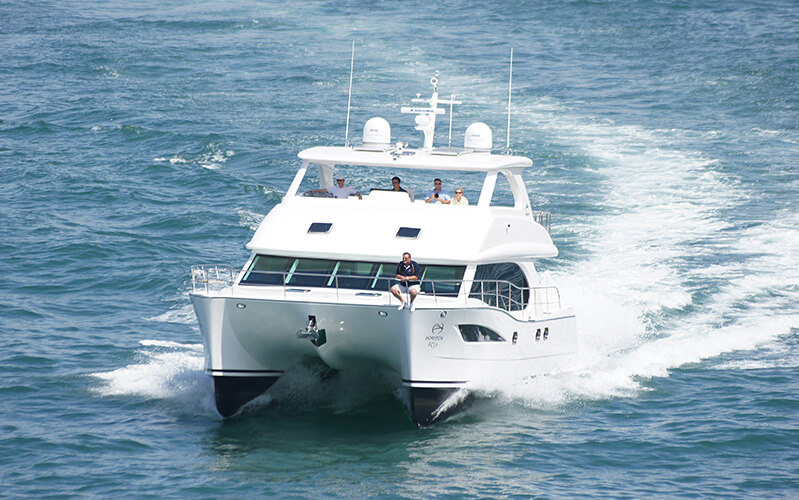
Before delivery to its new owner, every Horizon yacht undergoes a rigorous sea trial involving a third party survey to ensure proper systems operation and maneuverability. The maneuvering trials include a speed test, turning circle, emergency stern propulsion, stopping inertia, zigzagging with power loss stability tests and a full-power endurance test. These tests also include sophisticated data analysis of frequency and harmonics onboard and include trim level tests at varying power loads. Furthermore, all major equipment, such as anchors, thrusters, safety equipment, and fire-fighting systems, will be tested, and detailed records of all these tests are kept in a database for future reference.
ERP Management System
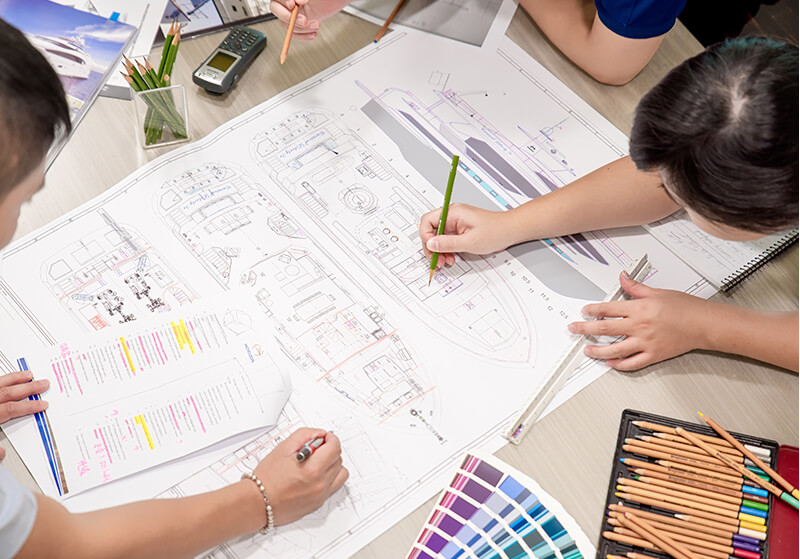
“Define your Horizon” is not just a slogan -- Horizon makes every effort to ensure that a customer’s dream will become reality. Managing the various requirements for each customer is not a simple task and requires an extensive system of checks and balances to assure every detail is attended to and each request fulfilled. To achieve this goal Horizon developed its own ERP system to supervise every yacht order, from the initial discussion and layout to the delivery and after-sales service. This system covers customer's input, construction details, product schedule, material procurement, quality checks, and customer feedback. Customer’s visions are translated into thousands of construction orders and material lists, and the system organizes that information, delivering it to the right person at the right time.